About Dark Side of the Loon
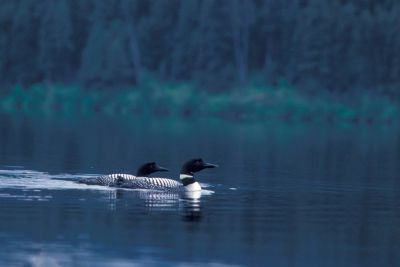
The eerie calls and striking black and white plumage of the common loon captivate those of us who spend time on northern lakes and ponds between April and October. Then the loons disappear. Quiet descends. Where do they go? How do they survive in winter?
Common loons change their brilliant breeding plumage for dull feathers that provide better camouflage in winter, but make them less obvious in the marine environment. They seldom call, so it's easy to miss them even in the bays and harbors we frequent.
Exploring The Dark Side of the Loon, you visit two "loon pools" (protected winter gathering grounds). On the east coast at North Carolina's Cape Lookout National Seashore, conservation biologist and ornithological expert Dr. Paul Spitzer, is our guide.
On the west coast in Morro Bay, California, biologist and aviculturist Darwin Long conducts the only long-term and detailed study of wintering common loons. He has been banding and studying loons amidst the remaining fishing fleet as well as the kayaks and yachts of what is now a busy tourist mecca.
In Massachusetts, wildlife veterinarian Dr. Mark Pokras, with his students and colleagues, has necropsied dead loons for 20 years to understand the causes of their mortality, both natural and human caused.
You'll learn how scientists in the field and laboratory unlock the mysteries of a bird that has survived for 60 million years. And you'll discover how loons are helping scientists to understand the perils loons face in winter, and how humans can help ensure their survival - and ours.
Music by David Budbill on shakuhashi. David wrote poems, plays, and novels in the Northeast Kingdom of Vermont. Since his death in 2016, David's daughter Nadine Budbill has maintained the Judevine Emailite with dates and locations where David's work is being read or performed. Contact Nadine Budbill to receive updates.
Reviews
"TWO THUMBS UP for the insightful and local nature documentary, The Dark Side of the Loon by independent filmmaker Gail Osherenko, that appeals to all nature lovers. Osherenko's science documentary breaks new ground in the unexplored venue of loon migrations with fabulous lake and coastal film footage, including beautiful Morro Bay. Osherenko is a compassionate story teller, who captures the loon under her lens with incredible sensitivity that touches the heart. Osherenko delivers diversity, clarity, and an environmental mission with top-notch local and national ornithologists." -- Debra Piot (Consultant, writer on human ecology and biodiversity conservation)
"Amazing documentary and very local. if you have any interest at all in nature you have got to see this movie." -- San Luis Obispo International Film Festival filmgoer
"If, like most, you've never heard a loon call indoors, you are in for a treat. What is loud outdoors is jaw-dropping in a laboratory... Little known facts about loons are laid bare in this film: loons seldom call during winter: their striking black and white plumage is shed, replaced by a rather dull brown, until new flight feathers grow; and they remain flightless throughout their molting period. An unexpected and lovely surprise is the music in the background, provided by poet David Budbill on shakuhachi, a bamboo flute." -- Jennifer Hersey Cleveland, The Barton Chronicle
"Our local Maine Audubon chapter (Downeast Audubon) offered a viewing of your film Dark Side of the Loon at the Blue Hill Public Library and I wanted to tell you how much we all enjoyed it. We had about 50 people in attendance and we all learned a great deal about "our" loons as well as those out west. The photography was great and we really connected to the 3 people you chose to interview. A job well done!" --Leslie Clapp, Downeast Audubon